


Build Resilience-Centered Skills Today
Educators and supportive adults play a critical role in helping children and youth thrive. This free training equips them with the knowledge and strength-based skills to support children and youth who have experienced trauma.
available languages
Be A Source of Support
For children and youth who have experienced trauma, it is important to have positive relationships with adults they can trust. By building the skills needed to recognize and respond to signs of trauma, adults who work with children and youth can be an important source of support.
Our Impact
Source: Participant self-reported data (2020 - present)
What Participants Will Learn
The Supporting Children and Youth Experiencing Trauma training includes four online sequential sessions that you can take at your own pace. Each session focuses on learning and practicing skills that can be used immediately with children and youth. Participants will hear from educators, mental health experts, students, and families, while reflecting on their own goals and intentions to be trauma-informed.
-
Explain what trauma is and how it presents itself in children and youth
Describe your role as a trauma-informed educator or supportive adult and how you can use the 4 R's of a trauma-informed approach
Recognize your mindset when faced with challenges
Reframe your mindset using the Awareness, Pause, Reframe technique
-
Recognize when and how Adverse Childhood Experiences (ACEs) and other potentially traumatic events affect one’s ability to learn and engage
Understand what it means to be a trauma-informed mandated reporter
Recognize how implicit biases can affect efforts to build supportive relationships
Identify strengths and protective factors in children and youth
Practice an effective approach to forging stronger relationships and helping children and youth build resiliency and positive coping strategies
-
Learn how trauma manifests in communities and why communities of color are disproportionately affected
Recognize how implicit bias can influence perceptions of trauma and who may need help
Apply the 4 R's in the context of traumatic events in the community
Tailor specific classroom teaching strategies to the neighborhood and community context to avoid re-traumatization
-
Apply the 4 R's to support children and youth who have experienced trauma
Apply the 4 R's to facilitate conversations with families and caregivers
-
Understand how conflict & displacement can affect individuals physically, emotionally, and socially
Understand how conflict & displacement impacts youth and the family system
Apply the 4 R's of a trauma-informed approach framework to the context of conflict and displacement
-
![]()
Session 1:
The Trauma-Informed Educators and Supportive Adults We Want to Be
-
![]()
Session 2:
Foundations of Trauma and Resilience
-
![]()
Session 3:
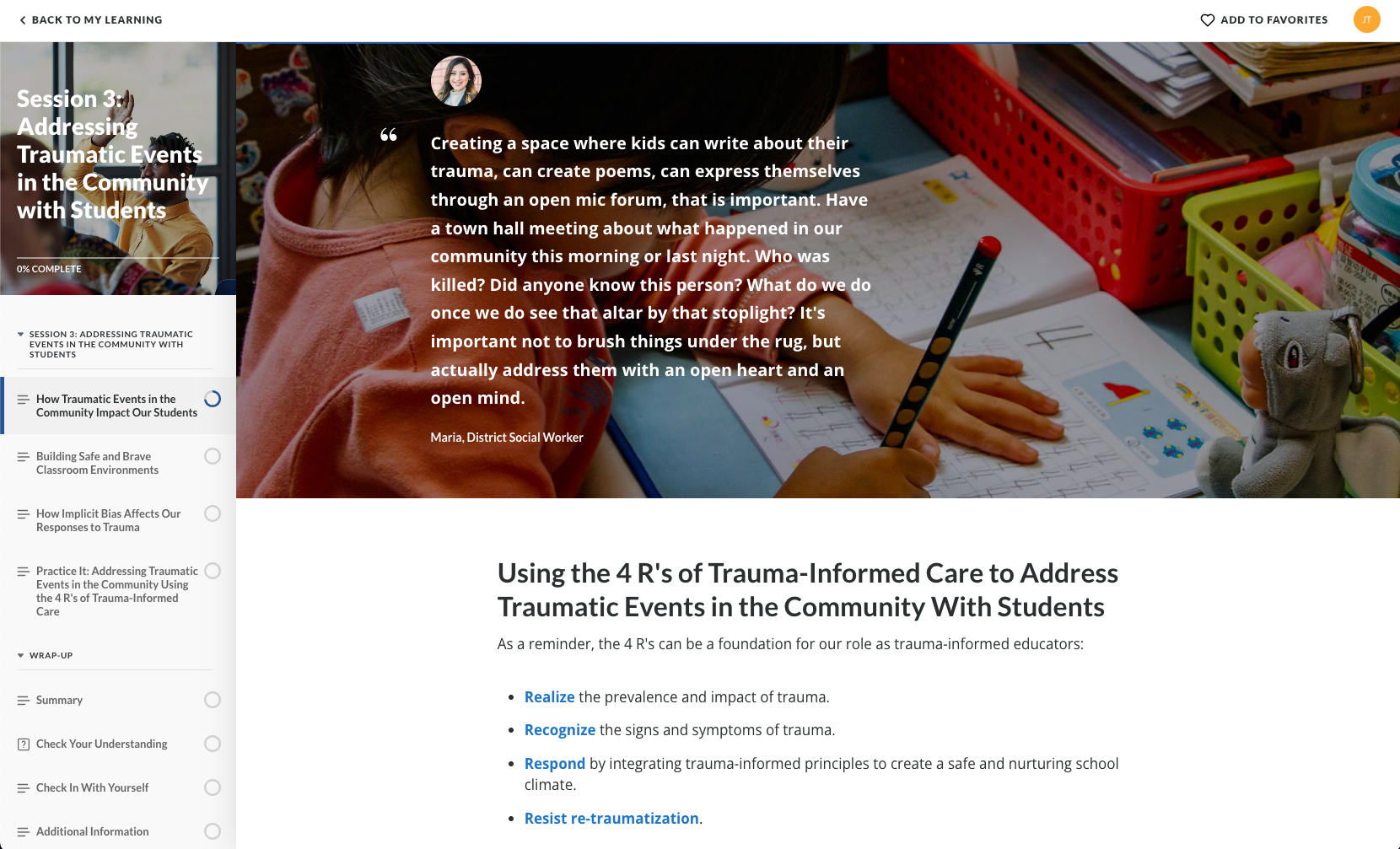
Addressing Traumatic Events in the Community with Children and Youth
-
![]()
Session 4:
Addressing Trauma with Children, Families and Caregivers in One-on-One Settings



What Makes This Training Unique
-

Learn by applying skills
80% of the training focuses on skills that educators & supportive adults can apply in the moment with the children & youth they work with.
-

Hear from peers
The training contains the voices and stories of peer educators, families, caregivers, and children sharing their lived experiences.
-

Build personal resilience
The training applies adaptive leadership theory to help educators & supportive adults build their own resilience and skills to support children and youth.
-

Focus on diversity, equity, and inclusion
The training highlights the impact that community-level trauma and implicit bias has – especially on students of color.
-

Go at your own pace
People who work with children need the flexibility to develop skills on their own schedule. This digital training lets them control the pace and come back to it when they can.
-

Learn the 4 R’s framework
The training is grounded in the Substance Abuse and Mental Health Services Administration's (SAMHSA) 4 R’s of a trauma-informed approach, an easy-to-remember framework that can be used in many situations.
How You Can Support Youth Wellbeing
-
![]()
For Participants
Take this free training to recognize the signs of trauma and build skills to respond effectively
-
![]()
For Groups
Enroll as a group in trauma-informed training
-
![]()
For Advocates of Youth Wellbeing
Collaborate with us to ensure that youth feel safe and supported


Brought To You By


Endorsed by





What Participants Have Said About The Course

“I use the skills I learned daily. These skills are essential to supporting not only our students, but also ourselves.”
– School Administrator

“I liked that the course was completely self-paced. That helped me to keep my own stress levels in check since I could complete the course at my leisure.”
– Speech Language Pathologist

“I appreciated hearing from actual teachers and staff on the front lines. It helped to hear how my peers handled specific situations and approached conversations with their students.”
– Elementary School Teacher

“Every teacher in our school should be required to take this training. I think it should be mandatory each year.”
– School Counselor
Frequently Asked Questions
Please contact us if you have more questions.
-
This training is based on the “4 R's of a Trauma-Informed Approach,” a tool developed by the Substance Abuse and Mental Health Services Administration with input from researchers and trauma survivors.
The 4 R's:
Realize the prevalence and impact of trauma
Recognize the signs and symptoms of trauma
Respond by integrating trauma-informed principles to create a safe and nurturing school climate
Resist re-traumatization
-
This series is designed for any adult who works with children and youth. The skills and perspectives shared are relevant across many roles, such as paraprofessionals, school-based service providers (e.g., physical, occupational, and speech therapists), coaches, librarians, and staff at youth-serving organizations.
Whether you work in a school, a community program, or another setting, you’ll gain tools to create supportive, safe, and empowering environments for young people.
-
This training is free of charge and open for you to share with colleagues, friends, and your community.
-
The training series has four sessions, each approximately one hour long. The sessions are self-guided and on a digital platform.
Learners have found it helpful to do one session per week so that they can practice the skills and techniques after each session. The four-session series is not intended to be completed in a single sitting. However, you can set your own pace.
We do ask that, once started, the training be completed within four to six weeks so that we can open more slots to additional educators.
-
Absolutely! Completing the training as a group makes it more meaningful. Participants can share tips, real-life experiences, and support each other’s learning. A discussion guide is included to help guide conversations and reinforce key lessons. See our group implementation resources to get started.
If you’re a school or district administrator considering this training as part of your professional development (PD) program, please contact us. We’ll help you design the right setup for your group and provide additional information about next steps.
For larger organizations, The Mayerson Center offers advanced support for group implementation, including registration help, progress reports, facilitator coaching, and trauma-informed care assistance. Contact us for details and pricing.
-
It depends on your state’s requirements. When you complete the course, you’ll get a certificate for four hours of learning. Share it with your program administrator to see if it qualifies for credit.
-
Please visit the "Get Started" page for guidance on technical trouble-shooting